

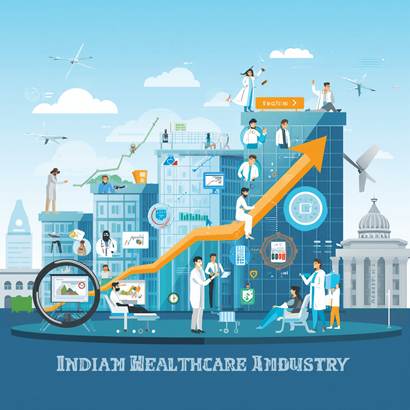
Experts predict that by 2030, the role of digital technologies in healthcare would have transformed from providing support to foundational engine of medical practice. The focus would be more of providing proactive care rather than traditional approach of reactive sickness care. The shift is towards predictive, preventive, participatory and deeply personalized approach, moving healthcare from the boundaries of Institutions towards combination of hospitals, home and virtual care. The world doesn’t just need more healthcare providers, rather it needs leaders who understand the language of both the stethoscope and mobile application.
The past few years, especially covid pandemic has taught a major lesson. The world can stop but healthcare cannot. One may not travel or buy a phone during crisis but cannot put a pause on health condition. Healthcare is a fundamental necessity, not discretionary spending for every individual. It is the only industry that is “recession proof”, always busy because the rest of the world has a problem unlike travel, retail, entertainment, or tech industries that are volatile. The expanding middle class economy, aging population, chronic disease burden has led to increasing demand of higher quality, more transparent, and tech-enabled healthcare services. There is an insatiable need for professionals who can help to deliver healthcare services ensuring hospital efficiency without compromising quality and patient safety.
The Indian Healthcare Industry valued around 180 bn in 2024 is witnessing an accelerated growth driven by expanding hospital infrastructure, government initiatives, rise in demand for non-communicable disease treatments, increased uptake of health insurance and digital technology proliferation across diagnostics and medtech segments.

Hospitals are no more “buildings with beds”, they are turning into “Smart Hospitals”. They are running a marathon to keep pace in the evolving digital panorama, to ensure quality and cost-effective care by integrating artificial intelligence (AI), deep learning, robots, genomic data and internet of things (IOT) for providing early diagnosis, tailored treatments, remote monitoring and patient tracking.
The question of the hour is not who helps healthcare organizations be it public, private or an NGO to undergo these transitions, rather what skills are needed for these transformations. What required is an “Architect of Care”, a “Bridge Leader”, who understands the fears of the staff and turns them into confident adopters of new technology. When a hospital invests crores of money for digital transformation, say for installing a AI based tool, it should be ensured that AI based technology is ethically safe, accurate and help in optimizing the clinical workflows rather than confusing the doctors. The patient data need to be safeguarded, made certain the patient’s privacy is maintained as per regulatory laws like the Health Insurance Portability and Accountability Act (HIPAA) and Digital Personal Data Protection (DPDP) Act. In the digital era, the fundamental skill set required is not in-depth technical knowledge, but technical empathy coupled with strategic authority to manage advanced digital tools, a know-how of what, where and when to use them. It isn’t about managing a building or an organization. It is about managing an integrated network of healthcare stakeholders, digital tools and workflows while focusing on patient outcomes.
The important question is “How to acquire these skills?”. A management degree in healthcare, a 2-year Full-Time MBA Equivalent PGDM Program (Hospital and Health Management) provided by IIHMR Delhi helps in acquiring the relevant skills, the capability to interact both with a software engineer and a surgeon. It does not replace one’s medical or scientific expertise it amplifies them. It pushes the individual to redesign themselves, become an innovator, a quality guardian, a strategic consultant or a digital healthcare leader. One doesn’t “fill the role” but metamorphize into any unique role they envisage for themselves in their professional life. Whatever the basic training may be, there is a role for everyone. Whether one has a clinical background, a lab or technology edge, a pharma grounding or a fresh undergraduate degree, management training in Hospital and Healthcare Management gives the seat at the table where the big decisions are made. It equips the aspiring student with a rosary of skill sets, a compendium of language that allows seamless interaction across the healthcare sector.

The future of modern medicine is being chiseled in data centers where our DNA is being analyzed, in boardroom meetings where strategies are debated, mapped in the visionary plans of health organizations. The true revolution is happening in bringing the healthcare to the “doorstep” of the patients, through decentralized healthcare delivery models, be it ‘Hospital-at-Home’ models that turn living rooms into high-tech recovery suites or “Phygital (Physical + Digital) Clinics”, that bring specialist expertise to the most remote corners of the globe through telemedicine and IoT. The tools and trade of future healthcare is digital, but the hands that wield them should be strategically trained.
PhD, PGDM, PGDCM, PGPHI
Professor, FIAHSI
Faculty Coordinator FPM